
The program the community built
More than 35 sessions in Vienna and a seat waiting for you

For years, the question in our field was about proving how citizens' assemblies could work. That question has largely been answered. The harder one now is how to embed them in our institutions.
FIDE Forum is our answer to that question. From November 17 to 20 in Vienna, we are bringing the field together to work on what comes next: the institutions, the standards and the political support that turn a promising method into institutional practice.
What's in your program
Making it last. A large share of the program looks at what happens after the pilot ends. Sessions explore how deliberation can become part of the everyday work of parliaments, public administrations, schools, and entire sectors. The main questions is, what it takes to move from one successful assembly to a permanent practice.
Getting quality right. Practitioners will work on what makes a process good, from transparency and evaluation to safeguards against weak commissioning. On Thursday morning, the whole Forum will become one big deliberation on standards. Its results will feed into a new research program.
Who is in the room. Several sessions focus on inclusion. How participants are recruited and selected, how to keep them engaged until the end, how to involve stakeholders and young people, and how to design processes where every voice counts.
Beyond the assembly. Other workshops look at what happens outside the assembly room. How assemblies can connect with the wider public, support members after the process ends, and help societies handle polarization and crisis.
Tools and technology. The program also takes a practical look at digital tools. From AI that helps organize evidence to open source lottery software and a proposed European civic tech hub. Sessions will examine the technology now entering the field.
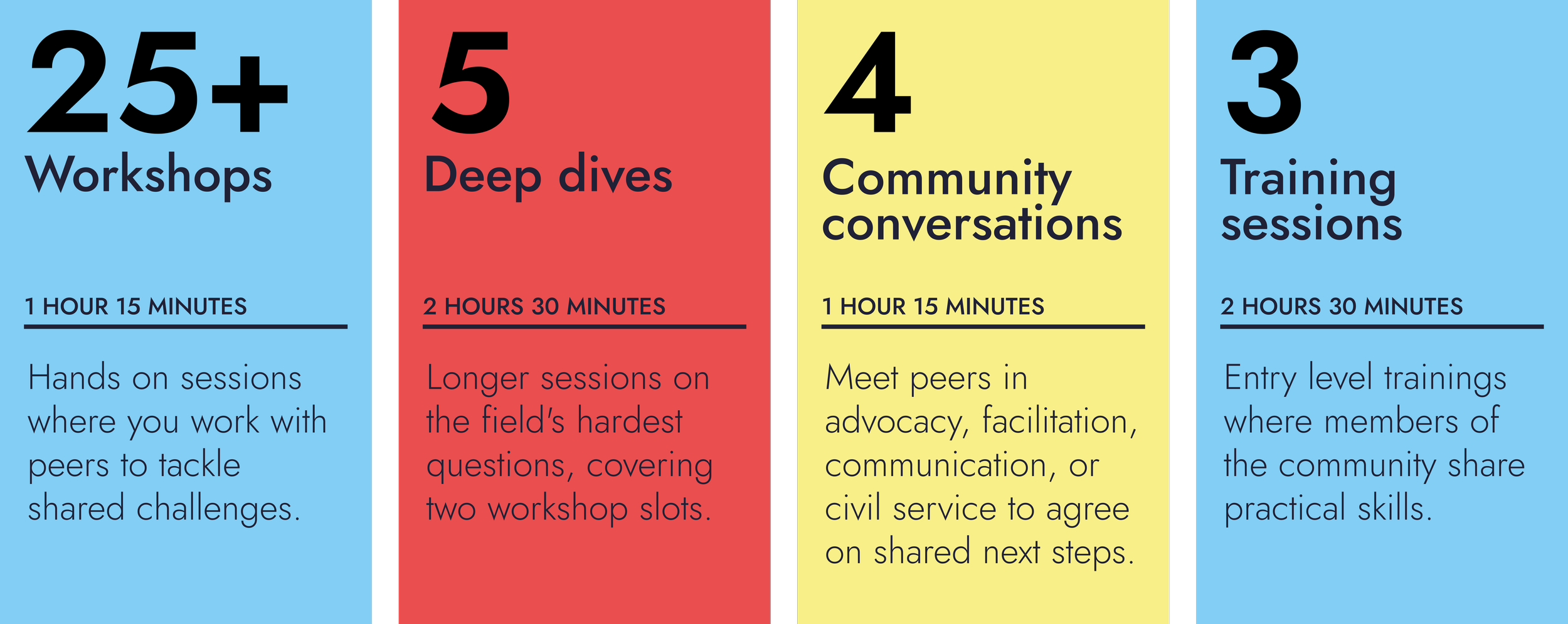
Tuesday, November 17. Public opening at Education Lab with city leaders from Vienna, Budapest and the Basque Country, in partnership with the Bertelsmann Stiftung. Free and open to everyone, with separate registration. Details below.
Wednesday and Thursday, November 18 and 19. The heart of the Forum at Brotfabrik Wien: workshops, deep dives, community conversations, the standards deliberation and a closing plenary where the community hands over its recommendations.
Friday, November 20. Entry level training sessions led by members of the community, at Brotfabrik Wien. Open only to registered Forum participants, with limited places.
Not registered yet? You have until October 30
Tell us a little about yourself and your organization, and we will confirm your place. Once confirmed, you can choose your sessions. Seats in each room are limited, so registering early gives you more choice.
Forum Pass: €300. For most organizations and professionals.
Supporter Pass: €1,000. Funds a free place for someone who could not otherwise attend.
Open Pass: free. For individuals and grassroots representatives facing financial barriers, with limited travel and accommodation support. Subject to eligibility and availability.
All prices include VAT.
ONLY FREE ON TUESDAY EVENING?
Public opening session
Built to last: politicians on democratic investment
Tuesday, November 17, 6:00 PM to 9:00 PM (doors open at 5:30 PM)
Education Lab, Vienna
The Forum opens with a public evening in partnership with the Bertelsmann Stiftung. Leaders from Vienna, Budapest, and the Basque Country will share what deliberation has brought to their own political work and what democracies risk when they treat their foundations as optional. A light reception follows the panel.
The event is free and open to everyone, but places are limited. Forum participants also need to sign up separately.
The case for deliberation as democratic infrastructure
We invest in roads, energy grids, and courts because we know what it costs when they fail. Democracy depends on the same kind of upkeep, and citizens' assemblies are one way mature democracies maintain it between elections.
Speakers
Jürgen Czernohorszky, Executive City Councillor for Climate, Environment, Democracy and Personnel, City of Vienna
Gábor Kerpel-Fronius, Municipal Advisor, Mayor's Office, Budapest Metropolitan Municipality
Ana Aguirre Uriz, Director of Open Government, Basque Country