
What we can learn from Lexington’s first Civic Assembly

A look at the latest independent evaluation in our Learning Series.
If innovation requires forward momentum, how can each new deliberative process inform the next?
That’s the question at the heart of our most recent case study, taking a look at Lexington, Kentucky’s first Civic Assembly.
Convened by CivicLex in March 2026, the Lexington Civic Assembly brought together 30 residents selected by lottery to consider two questions: Should Lexington’s Urban County Charter be reviewed? And should councilmember compensation be updated?
Over seven sessions and approximately 36 hours, participants learned about the issues, heard from experts, deliberated with one another, and agreed upon three recommendations.
As our team conducted their independent evaluation of the process - using surveys, interviews, and field observations - we were fascinated, not just because of what happened in Lexington, but because of what it can teach us about designing future assemblies.
Deliberation is part of the learning process
Participants began the Assembly with relatively limited knowledge of either issue. Average knowledge scores were 4.17 out of 10 for council compensation and 4.24 for charter review. By the end, both had almost doubled and risen to 8.83. Their confidence in participating politically also increased, from an average of 5.67 to 7.17. And those who believed ordinary citizens are capable of developing strong policy recommendations rose from 60% to 83%.
But this increase in knowledge wasn’t just a result of sitting through lectures and presentations. Participants consistently identified discussion with their peers as one of the most effective parts of their learning. Experts provided new information; deliberation gave members the chance to question it, hear different perspectives, and reconsider their own views.
As a result, our data demonstrates that 74% of participants said their views on council compensation changed during the Assembly, while 65% said their views on charter review changed.
Evaluation surveys found that more than a quarter of participants said they wished they’d had more time in the assembly, particularly for deliberation before voting. The value of an assembly, then, isn’t simply that participants become more informed, but that they have the opportunity to think together and engage in collective problem solving.
Sense of community doesn’t happen by accident
The assembly produced an extremely strong sense of community among participants, with 96% reporting this developed for them during the process. That feeling of community was supported by the assembly conditions.
“Group activities, team lunches, and time to chat and socialize were crucial to building trust and confidence communicating for all members, leading to the engaged deliberation and collaborative proposals which made this assembly a success.”
-Ken Docekal, Lead Evaluator for the Lexington Civic Assembly Case Study, FIDE North America
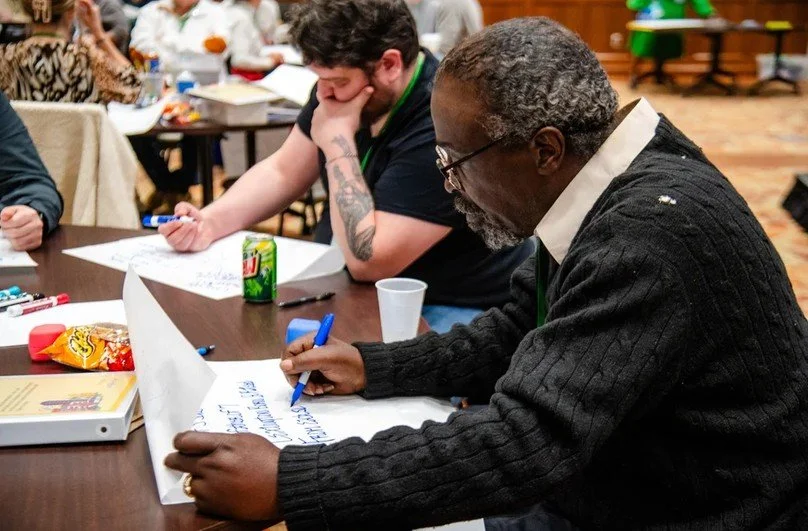
These elements can be easy to overlook when designing an assembly, but the evaluation suggests that relationship-building should be a guiding force in process planning.
A clear mandate can still leave room for more
While the assembly mandate consisted of two questions, participants ultimately produced a surprise third recommendation. Alongside recommendations on councilmember compensation and charter review, members proposed publicly viewable councilmember attendance and accountability expectations. The recommendation emerged from their own deliberations and passed with an 88.8% vote.
The other two recommendations also passed well above the Assembly’s 70% supermajority threshold - increasing councilmember compensation and establishing an eight-year charter review process. But the additional recommendation is where the real lesson lies, as it shows how participants could identify issues that sat just beyond the boundaries of their original mandate. A clear set of questions gave the assembly focus, and then the deliberative process - aided by strong facilitation - gave participants room to raise and develop a related governance concern. A well-defined mandate doesn’t have to constrain participants, as long as there is room to identify and respond to issues they encounter along the way.
Transparency comes with trade-offs
Lexington was the first assembly we’ve evaluated in which sessions were livestreamed, offering the public a direct window into the process. But the evaluation showed that greater public visibility came at a cost of some participants’ comfort.
“The goal of recording the assembly was to create greater transparency with the public, but we also found that some members did not feel entirely comfortable speaking openly as a result. These are trade-offs we need to look more closely at as recording assemblies become more commonplace.”
-Pim Trommelen, Learning Series Research Coordinator, FIDE North America
For future assemblies, this may mean thinking beyond an all-or-nothing approach to recording. Tiered transparency could include off-camera deliberative periods in smaller groups, or a clearer distinction between public reporting and full-session recording. The goal is meaningful public access without compromising safety and open participation.
Trust must be built to last beyond the assembly
The Lexington Civic Assembly left participants feeling that the process itself was legitimate and worthwhile. They rated its representative legitimacy at 8.96 out of 10, while trust in Lexington-Fayette Urban County Government increased from 5.62 to 6.96. 87% of participants supported broader use of civic assemblies in policy reform, 74% said assemblies should become permanent governance structures, and 83% said participating made them want to become more politically active.
But that confidence did not extend as strongly to what would happen next. Participants were less confident that the government would act on the assembly’s recommendations.
Government can be supportive of a process, but without a clear champion and definite feedback mechanisms, participants might be left unsure about policy impact. This gap points to an important tension - a deliberative process can build trust, legitimacy, and civic engagement while still leaving participants uncertain about its impact. For future assemblies, the pathway from recommendations to government action should perhaps be considered from the outset, rather than treated as something that begins once the assembly ends.
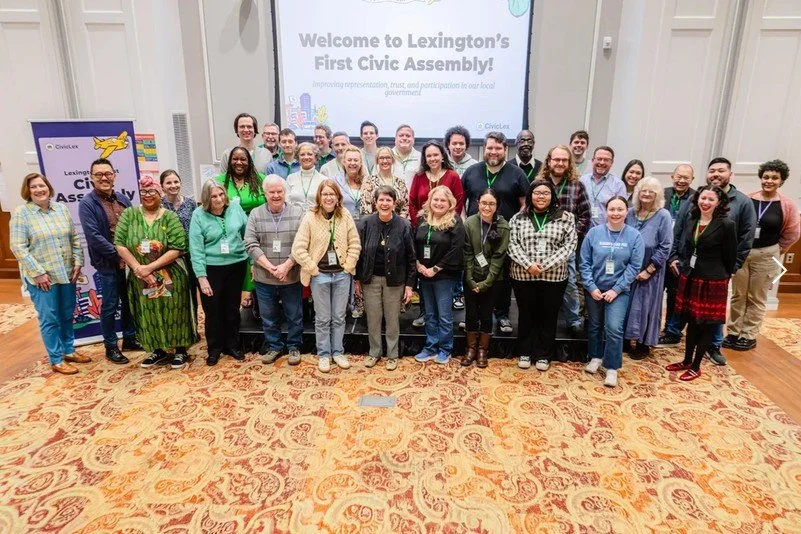
For us, the takeaways from the Lexington Civic Assembly evaluation are proof of why we do our learning series. Our case studies give us evidence of what worked, while also highlighting the trade-offs future assemblies will need to navigate. Lexington is our fourth case study, with two more coming later this Fall. Each assembly is different, and none provide an exact blueprint to follow. But with every new independent evaluation, we have the chance to ask better questions, gather stronger evidence, and carry useful lessons into the next process.
Read the full case study for the Lexington Civic Assembly here.
What We Are Up To
Partnerships with Local Citizens’ Assemblies
The City of Cambridge has officially launched its first-ever Civic Assembly. Letters have been sent to residents inviting them to join the lottery on October 5th and be selected as a participant. We’re thrilled to be a part of this work, advising and training the Cambridge team as they prepare to launch the process.
Next month, we will be co-hosting a Civic Assembly school with the City of Richmond. Speakers include members of the local community as well as representatives from FIDE, CivicLex, the City of Boulder, and Unify America.
We are in ongoing discussions with cities around North America to build capacity for these processes - and would love to hear from more. Contact us if you are interested.
Deliberative State Governance
As assemblies grow at the local level, FIDE's Deliberative State Governance program helps to extend local impact. By working with Governors' offices, state Cabinet Secretaries, and State Legislators, DSG ensures that local assembly work, like the CA in Lexington, is understood by state electeds. This learning can create:
Greater legitimacy for the local assembly's policy work.
Permission structures to increase citizen voice into policy.
A catalytic function to help raise local, public/private resources.
If assemblies are to successfully scale, local demand must grow concurrent with local resources; state leaders must be looped into work at the local level. In Kentucky, we are honored that the Commonwealth's Secretary of State, Michael G. Adams, is also a FIDE Deliberative State Governance cohort member, saying, “I am proud to support the DSG cohort and the broader work of FIDE North America...Kentucky is committed to learning, participating, and helping demonstrate what is possible when we put the public back in public policy."
For more information on the DSG program, please contact our Strategic Director, Deliberative State Governance, Kara Revel Jarzynski: kara@fidemocracy.org.
Events

This training will cover:
• Designing a citizens’ assembly from start to finish
• Building a team, a program, and a run sheet
• Drawing on a full toolkit for deliberation
• Designing a learning journey for assembly members
• Managing dysfunction, mediating, and leading large-scale dialogue, deliberation, and voting
More Voices, Fairer Outcomes? The Promise of Citizen Assemblies
Webinar: September 21st, 1-2pm ET

In the News
— Cambridge Day: Civic assemblies, common in Europe, have helped build trust (Published August 19th, 2026)
— WTNH8: Connecticut Citizens' Assembly on Property Taxes meets to discuss recommendations (Published August 29th, 2026)
— City of Cambridge: City of Cambridge Launching Its First Civic Assembly on Surveillance Technology (Published September 2nd, 2026)
— KQED: Oakland Mayor Lee Says She Will Try to Fund Civic Assembly’s Vacant-Lot Ideas (Published September 14, 2026)