Innovation in Action: Reflections from Our Summer Interns and Fellows

This summer, our Democracy Intern and Innovation Fellow brought fresh perspectives to some of the most important questions facing deliberative democracy. Through research and evaluation, they explored both the immediate and lasting impacts of citizens' assemblies. Their work examined everything from the skills participants gain through deliberation to the critical work of ensuring recommendations lead to meaningful action. In the reflections below, our Summer Democracy Intern, Olivia Sisson, shares how assemblies empower participants with the confidence and tools to navigate difficult conversations long after the process ends, while our Summer Fellow, Henry Grieco, takes a look at how assembly recommendations move from ideas into implementation. Together, their insights highlight that the success of citizens' assemblies lies not only in the decisions they produce, but also in the people and institutions they continue to shape.

Olivia Sisson, Democracy Intern
Over the past two months I have worked with FIDE North America’s Communications team, helping with messaging surrounding citizens’ assemblies. Through this work I realized that one of the major benefits of citizens’ assemblies is often overlooked: the skills gained to be able to hold your own deliberations. citizens’ assemblies provide participants not only with a group growth, in which people come to a solution through deliberation, but also with personal skills that are needed to have productive everyday deliberations surrounding polarized topics.
From reading the Learning Series Case Studies to better understand FIDE’s work, I saw that citizens’ assemblies connect people better to their government, and give them easy accessibility to other citizens. However, the greatest change I observed from the Case Studies, that sometimes goes unnoticed, is participants' relationships with themselves and their own voices, develop exponentially. At the Boulder Valley Community Assembly, 15% of participants had an increase in confidence in capacity for civic engagement.
A critical part of the design of a citizens’ assembly is that all participants are informed on a topic with the same basis of information. This was what drew me to FIDE and their work with citizens’ assemblies, and it remains my favorite aspect of the citizens’ assembly process.
The 1-2 day learning period in citizens’ assemblies allows people to begin their thinking together and counter any false-information they may have observed prior. This aspect of deliberation is critical to everyday discussions as well. In the present day, conversations are being increasingly challenged by differences in information. Social media and different kinds of news sources are causing people to debate facts. I have learned that citizens’ assemblies are designed to let participants start by learning together. This model can be used in a personal deliberation by assuring you and the person you converse with have the same background of knowledge, to avoid misinformation and disinformation.
Citizens’ assemblies teach people that there is a way to find common ground on polarizing topics. While interning at FIDE, I had the opportunity to analyze recent survey results of past assembly members and see that 94% of respondents stated they would like to participate in a greater assembly alumni network soon-to-be created by FIDE. Their top incentive, 73% of participants noted, was “Working with other like-minded individuals to ensure new policy reform.” This signals renewed interest in deliberation with others and motivation to continue conversations that began at citizens’ assemblies. I observed that their top incentive highlights the strength of the skill of participants in the assemblies. Many are desiring to converse with “like-minded individuals,” and the citizens’ assemblies fostered this “like-minded[ness].” Participants have engaged together and now have a shared understanding of how to navigate a difficult deliberation. They now desire to have conversations like their past ones with people who have the same skills their assembly participation gave them.
Citizens’ assemblies harbor discussions in which people have differences of perspectives. Participants in the Boulder Valley Community Assembly reported an 84% increase in empathy for differing perspectives. From assemblies, participants believe more in their abilities to facilitate difficult conversations on their own. The confidence participants gain is crucial to their future confidence to participate in daily conversations that can be just as difficult to discuss as assembly topics, but are not facilitated. Polarization is making people want to avoid difficult conversations, but difficult deliberations are most needed during times of extreme polarization.
FIDE has taught me how effective a model such as a citizens’ assembly can be not only the short term, but the long term. Assemblies teach participants skills that will aid them through all difficult discussions in the future. Merely by participating in citizens’ assemblies people are more motivated to be involved in critical conversations, feeling more secure in their voices. Citizens’ assemblies challenge people to be uncomfortable and leave participants with skills to have their own healthy deliberations. When people have the ability to conduct productive deliberations on their own, they are contributing to a future where more people are engaged in deliberative democracy. As I enter my senior year of high school, I am going to initiate difficult discussions with peers and share FIDE’s citizens’ assembly benefits so that they can facilitate strong deliberations themselves.

Henry Grieco, Summer Fellow
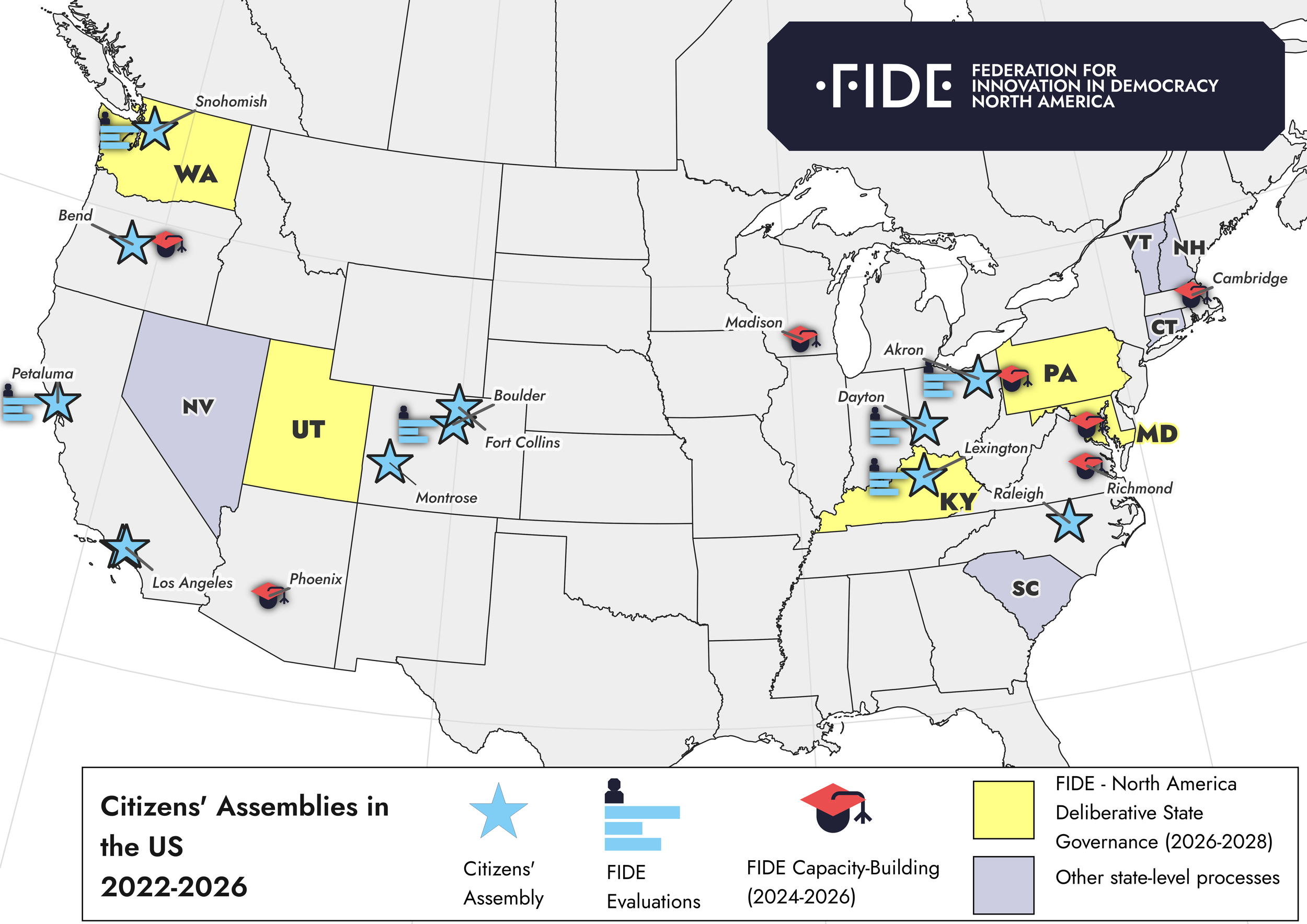
This summer, my research focused on what happens after a civic assembly completes its work. I analyzed eight assemblies (Boulder, Fort Collins, Akron, Lexington, Raleigh, Bend, Petaluma, and Los Angeles) to better understand how, when, and if their policy recommendations were implemented. For each case I traced the recommendations through city council meetings, staff reports, ordinances, and other public records. I then compared the cases to identify broader lessons about what I believe makes implementation successful.
One of my biggest take-aways is that there is no one size fits all approach to implementation. Assemblies address different types of issues and produce recommendations that require different responses.
Across the cases, however, the most important factor I saw was accountability from the start of the process to the end. This included securing a commitment to respond from city councils, maintaining communication after the assembly ends, and clearly explaining whether and how each recommendation would or would not be implemented.
If people are able to hold the appropriate governing body accountable from the start of the process to the finish, my research led me to believe that is the best chance for civic assemblies to be successful. In looking at the eight case studies, my recommendations were as follows:
Prior Commitment: Follow Akron’s lead. In signing the Memorandum of Understanding and laying out how they will respond and the specific timetable of when it should be expected, they allow for their constituents and assembly members to hold them accountable from start to finish.
Specific Remits on Defined Topics: Fort Collins and Petaluma are the best examples of this. These assemblies met to discuss specific development projects. I believe this once again provides the best opportunity for the governing body to be held accountable. The project either gets done or it doesn’t; the suggestions either get implemented or they don’t. For comprehensive plans or more general policy suggestions, it gives more room for the recommendations to be changed or be pushed off into the future. I also want to give credit to Lexington here. Although they were looking to make changes to their Charter, they kept the mandate narrow and the assembly made their recommendations very specific and easily implementable.
Ongoing Communication: Boulder nailed this. They not just committed to responding, but actually told people specifics of where recommendations were. Providing recommendation by recommendation analysis and updates like this from the governing body provides an easy way to hold them accountable. And in places where Boulder did not accept the recommendation, they specifically outlined why and if there was potentially another solution.
I had a great time working with FIDE this summer. The internship gave me a much deeper understanding of civic assemblies, but also the work required after deliberations end. An assembly's success should not be measured only by what takes place during the assembly and the quality of recommendations, but also by whether governing bodies adequately respond and address the concerns of the public.
What We Are Up To
Partnerships with Local Citizens’ Assemblies
Nevada - This August, we will be supporting the Nevada Forum on their design and approach to a statewide citizens' assembly. The Nevada assembly will host ~50 Nevadans from across the state and take place in Las Vegas from August 28 to 30. Deliberation will be informed by a lengthy online and in-person consultation process that started in March, with recommendations landing in the state's legislature.
Vermont - We are headed to the Green Mountain State for training at the end of the month, hosted in partnership with local leaders, the Vermont Council of Rural Development, and the Vermont Sustainable Jobs Fund. These groups are looking for new mechanisms for inclusive public engagement in tough community decisions.
Cambridge, MA - Two months after our workshop on citizens' assemblies with the City of Cambridge, the City Council voted to create a civic assembly to review policy on deploying certain technology for public safety. The assembly process is expected to move quickly in response to pressing public interest and debate.
We are in ongoing discussions with cities around North America to build capacity for these processes - and would love to hear from more. Contact us if you are interested.
Learning Series
On July 23rd, research and experience from our Learning Series team was put on full display at our webinar, 1,000 Citizens’ Assemblies Later: What’s Changed?
Co-hosted with People Powered and GloCAN, researchers, practitioners, and a participant from Lexington, Kentucky’s first citizens’ assembly reflected on how assemblies create change beyond policy outcomes.
A key takeaway was that impact cannot be measured solely by whether recommendations become policy, but also by the effects on participants, communities, and institutions. Participants often leave with greater knowledge, increased confidence in civic engagement, and a stronger willingness to engage with differing perspectives. Speakers emphasized that assemblies can strengthen trust and public dialogue even when recommendations are not adopted. Effective processes rely on representative participation, clear mandates, accountability, and ongoing support that helps participants feel heard and connected throughout the process. Shelly Kuhn, a participant in CivicLex’s recent Civic Assembly, shared that one of the most valuable aspects was building relationships with people from different backgrounds in an environment where everyone felt safe to share their experiences.
Looking ahead, panelists highlighted the need for more research, stronger follow-up after assemblies conclude, and a commitment to meaningful public participation rather than symbolic engagement.
Want to catch up on what you missed? Watch the recording and read the slides.
Find the resources referenced in the webinar here:
Theory of Change for Citizens’ Assemblies, Case Studies, and recent interview - Beyond Indicators: How Independent Evaluation Improves Citizens’ Assemblies by FIDE North America
Impacts of Citizens' Assemblies: A Summary of the Latest Research by People Powered
Impact of Citizen Engagement, contributed by Melisa Ross, GloCAN
The Global Citizens’ Assembly Deep Dives on Food & Climate by Iswe Foundation
5 Summary Reports of Roundtables for Renewing Democratic Participation by Columbia World Project
Deliberative State Governance
This past May, five cross-partisan, high-profile champions from Kentucky, Maryland, Pennsylvania, Utah, and Washington, traveled to Brussels, Belgium for DSG's inaugural international convening with over 31 elected officials, experts and deliberative democracy practitioners. Read the full after-action report here.
For more information on the DSG program, please contact our Strategic Director, Deliberative State Governance, Kara Revel Jarzynski: kara@fidemocracy.org.
In the News
— Seattle Times: How Snohomish County let residents weigh in on government AI use (Published July 27th, 2026)
— New America: Building the Foundation for Deliberation in Akron (Published July 27th, 2026)
— New Haven Independent: Tax The Rich More Or The Same? Vanilla Or Cookie Dough? (Published July 28th, 2026)
— Cambridge Day: ShotSpotter returns, at least temporarily (Published August 4th, 2026)
— For A New Democracy: "Why isn't everyone doing this?" (Published August 6th, 2026)
We’d like to congratulate our partners for the incredible work they are doing putting the public back in public policy. See the full scope of our advisory and evaluation work below.